
A dream is an intensely personal experience because it reflects your deepest feelings, emotions, values, and beliefs about life. Here are my answers to some frequently asked questions I encounter on dreams.
What is a dream? Where do dreams come from?
A dream is the result of your sleeping brain and mind processing your conscious and unconscious experiences of the last 1-2 days. This processing updates your mindset, your beliefs, your memories, your perspectives and feelings about life, and your sense of self. The dream experience feels real because this processing activates the same areas of your brain and mind that are activated when you are awake. For example, the visual areas of your brain are active when you are seeing something in a dream in the same way as they are when you are seeing something when you are awake.
A dream is also an intensely personal experience because it reflects your deepest feelings, emotions, values, and beliefs about life. It’s like a mirror that helps you to see and understand yourself and your life deeply, right into the depths of your unconscious mind. It helps you – once you know how to analyse or interpret it – to understand why you are the magnificent, unique being that you are. It helps you to understand your mindset – the way your brain and mind are wired – and this information empowers you to make changes to your mindset so that you can enjoy a more fulfilling, more meaningful life.
Read more:
About dreams
What is dream alchemy?
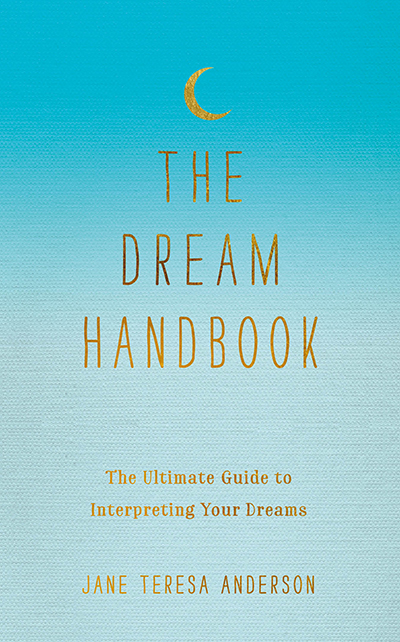
The Dream Handbook, Jane Teresa Anderson, Published by Piatkus
Dream alchemy is the name I give to exercises and practices you can do to rewire your brain or mind, to transform or reprogram those unconscious beliefs (identified in a dream) that are holding you back in life, that are blocking you from enjoying more of life’s positives. These exercises are also designed to help heal, to resolve issues, to open your perspective on life, to free you up to grow to your full potential. The exercises – sometimes visualisations, sometimes writing, sometimes bodywork, sometimes artwork, as well as other options – work by transforming personal symbols from your dreams in ways that transform the beliefs they represent.
Learn about how to create and use dream alchemy exercises in my book, The Dream Handbook.
Read more:
Rewiring the brain with dream alchemy
When affirmations and visualisations fail
How can I remember my dreams?
There are several different and easy ways to begin remembering your dreams. First you must want to remember them and believe that there is value in recalling your dreams. One of the reasons you may not be remembering your dreams is because you’ve grown up believing them to be unimportant. Another is that you’ve had a scary dream experience and you’ve turned off your recall, so allowing yourself to be ready to recall your dreams because you value how they can help you is an important step in remembering them. Another reason why you may not remember your dreams is that you may jump out of bed too quickly in the morning, giving yourself no time to recall. Dreams rapidly fade if you do not allow them the time to float into conscious memory. Here are some practical tips to help you remember your dreams.
Read more:
How to remember your dreams
How long is a dream?
They vary in length. Dreams later in the sleep are longer than the earlier ones. The last dream in an eight hour sleep can be 45 minutes long. Dreams happen in real time. If you dream of throwing and catching a ball, the dream takes the time that the throwing and catching would take. You might dream of taking a ten hour plane trip, but that dream might involve a couple of minutes of getting on the plane, a minute of looking out the window, a moment of panic as the plane dives, and a minute of your safe arrival at the end of the journey, just as a movie might depict a long journey in a few minutes. The dream, in this example, takes the same number of minutes as the scenario I have described.
That dreams happen in real time was discovered in the laboratory. Prior to this it was once believed that dreams occurred in flashes. This was largely based on the experience of a mid-19th Century French dream researcher, Alfred Maury, who dreamed a long involved dream about being in the French Revolution. At the end of the dream he was led to the guillotine and felt the pain as the blade came down on his neck. He woke up to find that his bedhead had fallen on his neck, and he concluded that this sensation had generated the whole dream which he experienced in a flash.
Why do dreams feel real?
The areas of your brain that are activated when you see in your dreams are the same areas that are activated when you see while you are awake. The same goes for what you hear, feel, touch, and taste. The same goes for the emotions you feel in your dreams, and for some of the memories your dreams touch upon. Dreams feel as real, in sensory terms, as waking life.
Add to this the fact that while you are dreaming you are oblivious to your usual waking life (unless you are lucid dreaming). The dream is the only experience you are aware of, so you believe it.
The Chinese sage Chuang Tsu, (around 350 BC), dreamed he was a butterfly. He totally believed he was a butterfly, just as you would do if this was your dream. He famously asked his students, “Am I a man who dreamed I was a butterfly, or am I a butterfly who is dreaming I am a man?”.
What is lucid dreaming?
Lucid dreaming occurs when you are aware that you are dreaming. It’s like being in two realities at the same time, your dreaming reality and your waking life reality. Technically you are aware that you are in bed and dreaming, at the same time as being deeply immersed in a dream.
I hear many people describe what they believe to be lucid dreaming but what they’re experiencing seems to be more like directing a visualisation that feels like a dream. In true lucid dreaming you experience both realities vividly. You can train yourself to fall into a lucid dream, but generally the process is that you are dreaming and suddenly you become aware that what you thought was real is actually a dream. (You can train yourself to trigger this realisation, to wake up to your dreams.)
Once you’re lucid dreaming, you can either just enjoy the amazing sensation, or you can take control of the dream and direct it in whichever way you wish, for as long as you remain lucid. What usually happens is that you slip in and out of lucidity. Some lucid dreamers just enjoy. Some use the lucidity to try creative ideas, problem solve, meet up with famous people to ask their advice, or to practice dream alchemy.
Read more: Inception:
Can you control a dream?
Why are dreams symbolic?
The areas of the brain that deal with logic and reasoning (largely the left brain) are less involved in dreaming than the areas of the brain that deal with emotions, feelings, sensations, and abstract, symbolic, big picture processing. While your dreaming mind and brain are processing your conscious and unconscious experiences of the last day or two (See Q1: What is a dream?) it’s your right brain that spins this processing into the big symbolic picture of a dream. This is why it’s easier to understand a dream if you consider it as a symbolic metaphor for what you’ve been going through in the last day or two – consciously or, more likely, unconsciously.
Have you tried to do a simple sum in a dream? It’s really difficult to add 5 + 3 in a dream. You’ll get 53, or May 3rd, or March 5th, or 1953, or a bunch of three and five year old children appearing as a solution to your dream problem. This is an example of the creative right brain at work, producing whole pictures or whole understandings instead of logical answers.
Symbols summarise whole pictures, whole understandings. They also stand for things that are deeply unconscious, that your conscious mind has not yet grasped in words. In this way, some of our deeply symbolic dreams may connect us to the spiritual aspects of our being, our deep wisdom which is, as yet, beyond full waking comprehension. Usually, however, the starting point is to consider what the personal symbols in your dream reflect about you and your mindset. (See Q1: What is a dream?)
Do dream symbols mean the same to everyone? What is the best dream dictionary?
Can you use a dream dictionary to interpret your dreams? No, absolutely not! While some symbols tend to have similar meaning for many people, even these are not universal. Our dream symbols are unique and personal. They are created by our own unique minds to express our own unique experiences and perspectives on life. There are techniques you can learn (and these are usually fun to do) to discover the meaning of your personal dream symbols. It’s also important, when analysing or interpreting a dream, to look at the big picture of the dream, rather than to focus on the symbols. There are other key aspects of a dream that need to be explored to come to a full understanding, and you can learn how to interpret your dreams by applying specific methods.
Read more:
Dream symbols: The personality question
What are some common dream symbols and what do they mean?
See my answer to the above question, Q10: (Do dream symbols mean the same to everyone? What is the best dream dictionary?).
What do recurring dreams mean?
A recurring dream reflects a recurring waking life situation or issue. If your recurring dream is unresolved (has an unresolved or unsatisfactory ending), it reflects an unresolved issue or unsatisfactory situation in your life. The dream is symbolic, but once you interpret it you’ll see a parallel between the problem in the dream and a problem in your life that you’re having difficulty resolving. (If your recurring dream is positive, with a resolved ending, it either reflects a happier recurring situation or, more likely, a positive solution to an issue that you’re not applying – in other words, your dreaming mind has a solution but you’re holding back from applying it.)
See my answer to Q1 (What is a dream?) which describes the process of dreaming. You’ll see in my answer there that your dreams reflect the last 1-2 days, as the job of your dreaming mind is to process your conscious and unconscious experiences of those last 1-2 days. So a recurring dream reflects a recurring situation: every time the situation or issue comes up, you have the dream as your dreaming mind works at making sense of it all. So a good tip, if you have a recurring dream, is to ask yourself when it first began, as that marks the beginning of the situation or issue. Looking back, you may realise what was happening for you back then when you first had this dream. Then, each time you have the dream, look back over the last couple of days until you see a pattern. Or, for a quicker approach, dream analysis goes straight to the point and identifies both the issue and the solution.
Can you stop a recurring dream?
Yes, by interpreting the dream to understand what the recurring issue is in your life. A recurring dream reflects a recurring unresolved issue (See Q12: What do recurring dreams mean?). Interpreting the dream helps you to see why you are having difficulty resolving the issue, and helps provide the solution. Dream alchemy (See Q2: What is dream alchemy?) helps you make the mindset changes that resolve the issue. Once the issue is resolved, the dream does not recur.
Read more:
Rewiring the brain with dream alchemy
How does PTSD (Post Traumatic Stress Disorder) affect dreams? Can dream therapy help heal PTSD?
When you have PTSD you may relive the traumatic experience over and over again in nightmares, or you may have dreams that are more symbolic than literal, but that are still distressing. Yes, dream therapy can help heal PTSD.
Read more:
Post traumatic stress disorder nightmares: a cure
What is the difference between a nightmare and a dream?
One person’s nightmare is another person’s bad dream. A nightmare is the name some people give to a frightening or extremely frustrating dream. If you feel fear in a dream, your body produces fear hormones such as adrenalin in exactly the same way as it does if you feel fear while you are awake. The fear hormones cause the ‘fight or flight’ response, or the freeze response. Your heart rate rises, your skin may feel cold, clammy, and goosebumpy, and you’re primed to attack, escape, or freeze on the spot. If you wake from a frightening dream and sit up in bed with your heart thumping and your skin clammy you may believe that something scary really has just happened because the physiological response is real. The same goes for extremely stressful dreams where your body produces the same stress hormones as it would for a waking life stressful situation, so you wake up feeling mentally, emotionally, and physiologically stressed from your dream – or nightmare.
Firstly reassure yourself that a nightmare is a dream, no matter how real it feels in your body, and then apply the same procedures as you would for any dream: interpret the dream to understand it, and then apply dream alchemy to help resolve the issue.
Can watching a scary movie or eating certain types of food like cheese give you bad dreams?
Yes, sometimes. Foods that cause you indigestion or discomfort can affect your dreams because the physical environment can impinge on dreams. When it comes to movies, if something in the movie resonated with a personal issue or stirred a pertinent strong emotion, it may work its way into your dream because your dreaming mind’s job is to process your experiences, particularly new or uncomfortable experiences. So don’t dismiss the dream because “I only dreamed that dream because I saw a scary movie”. It’s more important than that as the dream is exploring emotions and personal issues raised by the movie.
Read more:
Cheese, alcohol, movies, and dreams
Can you solve problems in your dreams?
Yes and no. Because your dreams are processing your experiences of the last couple of days, they’re also processing any problems or challenges that are on your mind. An unresolved dream (a dream with an unsatisfactory, problematic ending) reflects an unresolved problem in your waking life. In these cases, the dream fails to find a solution, but when you interpret such dreams you discover why your current mindset is blocking a solution, and, knowing this, the block can be released and an excellent solution found. So in this case the dream itself doesn’t come up with a solution, but analysing and working with the dream does.
Mostly as we process our experiences in dreams we tend to categorise them in our habitual ways, and you’ll see this when you interpret many dreams. This is their value: they reveal our habitual ways of approaching life, ways that often block or limit us.
At other times we breakthrough in our dreams and discover new ways of thinking, or consolidate recent new learning during our dreams, waking up with a shifted mindset – and a solution to a problem.
Remember that dreams are symbolic, not literal. Don’t take the dream solution (e.g. killing someone who’s annoying you) literally! Interpret the dream to find the solution.
Read more:
What’s your problem?
How to use recurring dreams to resolve practical life issues
Have any great discoveries been made in dreams?
See my answer to the above question, Q10: (Do dream symbols mean the same to everyone? What is the best dream dictionary?).
What does it mean if I die in a dream?

12 Key Questions to help interpret your death dream
Dreams are symbolic, so this kind of dream doesn’t predict death. You can’t apply a dream dictionary approach, as every dream is unique and personal, so look at the overall storyline of your dream and then see how it relates as a metaphor for your experiences of the day or two before your dream. For example, do you feel that an aspect of your personality is dying, and, if it is, is this a good thing (you’re ready to grow and change), or is this not such a good thing (you’re letting a key aspect of yourself slip away)? Or do you feel you’re losing your vitality? Have you been saying, “This will be the death of me”, almost tongue in cheek, and your dreaming mind is trying to process this? What feels like it’s coming to an end, and how do you feel about this? When you are being challenged by change, by choice or circumstance, this kind of dream can come up to reflect your experience of death of the old way in preparation for birth of the new.
What does it mean if someone I know dies in my dream?
12 Key Questions to help interpret your death dream
Everyone in a dream represents something about you, the dreamer. When we dream of other people, we are really dreaming about our own thoughts, feelings, beliefs, and judgements about them. What does the person who died in your dream represent to you? What’s their personality or approach to life? What can you learn about yourself by noticing what you think about this person? Why might this belief (that you hold about them) be coming to an end, dying off within you? How do you feel about this? Is it time to let go, to let the old ways die to give way for the new, or is it time to revitalise what is slipping away? You choose. (See my answer to the previous question: What does it mean if I die in a dream?)
